Portrait of Zhitong Klara Guan

Zhitong Klara Guan

PhD Candidate · School of Information, The University of Texas at Austin
1616 Guadalupe St.
School of Information, UT Austin
Austin, TX 78701

I am a PhD Candidate in Information Studies at the University of Texas at Austin, advised by Prof. Soo Young Rieh. Previously, I was a Research Associate at the APEX Group at HKUST working on accessibility technology research with Prof. Mingming Fan, and a Product Manager at Tencent's WeChat Group. I hold an M.S. in Industrial Engineering and Operations Research and a B.A. in Mathematics and Data Science (Double Major), both from UC Berkeley.

My research lies at the intersection of Human-Computer Interaction and Interactive Information Retrieval, with a focus on designing and evaluating Generative AI search systems that augment rather than replace human cognition. I am particularly interested in how AI-mediated search can support higher-order cognitive processes: sensemaking, critical thinking, decision-making, and creativity, and how interface design shapes the way people think and engage with information.

news 📰
Apr 2026 Upcoming travel to ACM CHI 2026 in Barcelona, Spain to:
Mar 2026 Excited to attend my first CHIIR conference! Presenting at the Doctoral Consortium and the Workshop on Generative AI & Academic Search. See you in Seattle.
Jan 2026 I passed my qualifying procedure, including a qualifying paper, written exam, and oral exam. Special thanks to my committee: Prof. Soo Young Rieh, Prof. Andrew Dillon, and Prof. Jacek Gwizdka for their guidance and support.
Oct 2025 Our work Enhancing Critical Thinking in Generative AI Search with Metacognitive Prompts was accepted at ASIS&T 2025. See you in Crystal City, Virginia.
publications
Metacognitive prompts paper thumbnail
ASIS&T 2025
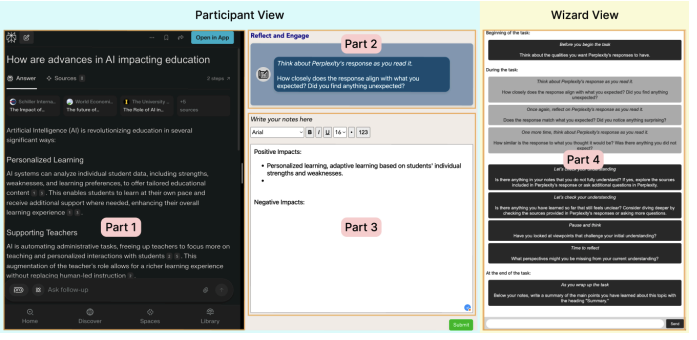
Enhancing Critical Thinking in Generative AI Search with Metacognitive Prompts
Anjali Singh, Zhitong Guan, and Soo Young Rieh
The growing use of Generative AI (GenAI) conversational search tools has raised concerns about their effects on people's metacognitive engagement, critical thinking, and learning. As people increasingly rely on GenAI to perform tasks such as analyzing and applying information, they may become less actively engaged in thinking and learning. This study examines whether metacognitive prompts designed to encourage people to pause, reflect, assess their understanding, and consider multiple perspectives can support critical thinking during GenAI-based search. We conducted a user study (N = 40) with university students to investigate the impact of metacognitive prompts on their thought processes and search behaviors while searching with a GenAI tool. We found that these prompts led to more active engagement, leading students to explore a broader range of topics and engage in deeper inquiry through follow-up queries. Students reported that the prompts were especially helpful for considering overlooked perspectives, promoting evaluation of AI responses, and identifying key takeaways. Additionally, the effectiveness of these prompts was influenced by students' metacognitive flexibility. Our findings highlight the potential of metacognitive prompts to foster critical thinking and provide insights for designing and implementing metacognitive support in human-AI interactions.
Human cognition project thumbnail
CHI 2025 Workshop
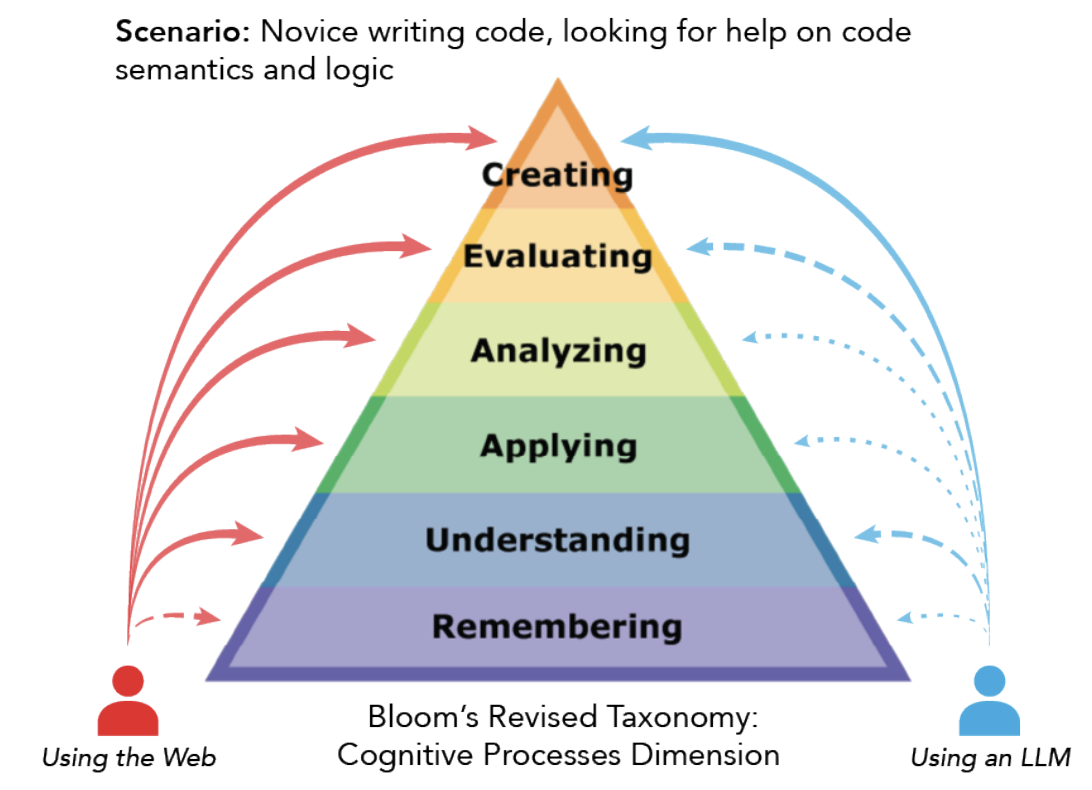
Protecting Human Cognition in the Age of AI
Anjali Singh, Karan Taneja, Zhitong Guan, and Avijit Ghosh
The rapid adoption of Generative AI (GenAI) is significantly reshaping human cognition, influencing how we engage with information, think, reason, and learn. This paper synthesizes existing literature on GenAI’s effects on different aspects of human cognition. Drawing on Krathwohl’s revised Bloom’s Taxonomy and Dewey’s conceptualization of reflective thought, we examine the mechanisms through which GenAI is affecting the development of different cognitive abilities. Accordingly, we provide implications for rethinking and designing educational experiences that foster critical thinking and deeper cognitive engagement and discuss future directions to explore the long-term cognitive effects of GenAI.
FetchAid project thumbnail
CHI 2024 🏅 Best Paper Honorable Mention
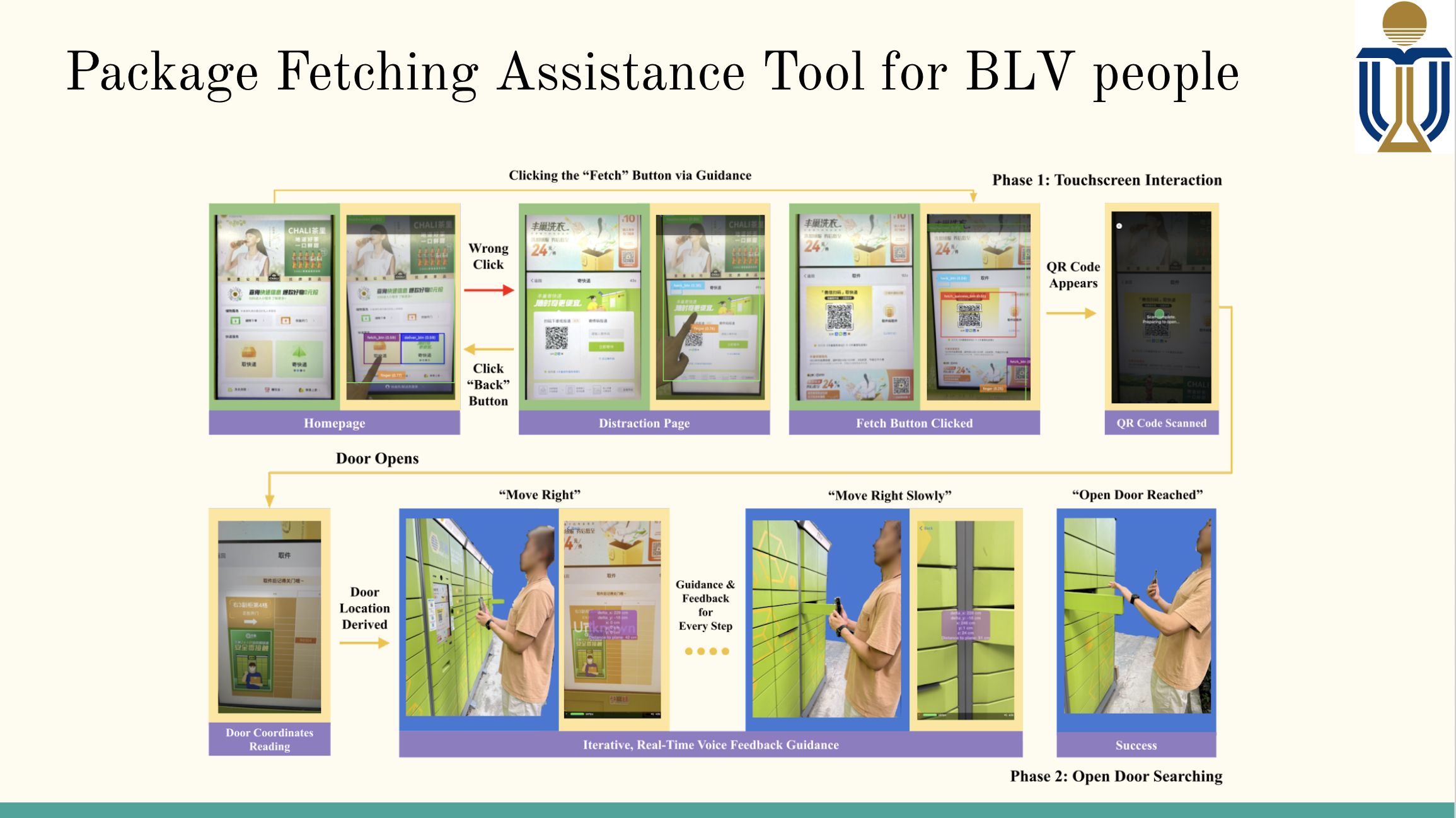
FetchAid: A Real-Time Intelligent Package Fetching Assistance Tool for People with Visual Impairments
Zhitong Guan, Zeyu Xiong, and Mingming Fan
Parcel lockers have become an increasingly prevalent last-mile delivery method. Yet, a recent study revealed its accessibility challenges to people with visual impairments (PVI). Informed by the study, we designed FetchAid, a standalone intelligent mobile app assisting PVI in using a parcel locker in real-time by integrating computer vision and augmented reality (AR) technologies. FetchAid first uses a deep network to detect the user’s fingertip and relevant buttons on the touch screen of the parcel locker to guide the user to reveal and scan the QR code to open the target compartment door, and then guides the user to reach the door safely with AR-based context-aware audio feedback. Moreover, FetchAid provides an error-recovery mechanism and real-time feedback to keep the user on track. We show that FetchAid substantially improved task accomplishment and efficiency, and reduced frustration and overall effort in a study with 12 PVI participants, regardless of their vision conditions and previous experience.
Education
2023 - Present
PhD, Information Studies
The University of Texas at Austin
2020 - 2021
M.Eng., Industrial Engineering and Operations Research
University of California, Berkeley
2016 - 2020
B.A., Mathematics and Data Science
University of California, Berkeley
Experience
2023 - Present
PhD Candidate
School of Information, UT Austin
2021 - 2023
Research Associate
APEX Group, HKUST Guangzhou
Before 2021
Product Manager
WeChat Group, Tencent
Teaching
Fall 2025
TA, Understanding & Serving Users
UT Austin · INF 382C
Spring 2025
TA, Intro User Experience Design
UT Austin · I 310U
Fall 2024
TA, Understanding & Serving Users
UT Austin · INF 382C
contact

Email: klarazt@utexas.edu

LinkedIn: klara_guan